What a dog is actually deciding
Dogs taste their food. Most of them get the same meal 730 times a year.
The label for that is picky eater. The research on how dogs choose describes something narrower, and testable.
You put the bowl down. Your dog crosses the kitchen, lowers his head, holds it there for about a second and a half, and walks away. Nothing is wrong with the food. Nothing being wrong with the food is why you bought it.
By the second week of this you have a word for him, and the word closes the subject. Picky. It sounds like a description. It behaves like a verdict, because once a dog is picky there is nothing left to look into. It is who he is. You are down to bribery, and to buying the fourth bag.
That word is doing a lot of work it never earned. A dog standing at a bowl is running a short, specific evaluation, and the pet food industry has spent decades measuring it, in kennels, with panels and scales and stopwatches. What the industry measures is real. What it cannot see is the exact thing you are standing in your kitchen hoping to see.
Here is what a dog is deciding, what the trade can and cannot record, and why the answer for a large share of so-called picky dogs is not a better bag. It is a longer menu.
The tongueA dog has about 1,700 taste buds. That is not nothing.
The number usually turns up as a put-down. The American Kennel Club states it flatly: “while humans have roughly 9,000 taste buds, dogs have only around 1,700”. A sixth of ours. From there it is one short step to the folk conclusion that dogs do not really taste, they just hoover, and that flavor in dog food is theater aimed at the person holding the credit card.
One sixth of a large number is still a large number. Dogs register the same four basic classes we do, sweet, sour, salty and bitter. They also carry one we do not: taste buds tuned specifically to water, sitting at the tip of the tongue, at the precise spot that curls when a dog laps.
Taste buds, by species
Counts as published by the American Kennel Club. Dogs detect sweet, sour, salty and bitter, and carry water-specific receptors at the tip of the tongue that humans do not have.
The differences from our own palate are more interesting than the shortfall. Reviewing how dogs and cats came to eat the way they do, the Bristol biologist John Bradshaw describes the dog as typical of its genus in carrying “a taste system that is rather insensitive to salt”. Salt is one of the main levers in human cooking. On a dog it is close to a dead control.
And when researchers want to find out what a dog needs rather than what it likes, they first have to get the liking out of the way. A 2018 study in the Journal of Experimental Biology opens on it as a premise rather than a finding: “Dogs and cats make short-term food choices based on palatability.” To learn anything about physiology, the team had to build four foods of deliberately similar palatability and only then watch what seventeen dogs chose across 28 days. Taste had to be neutralized because otherwise taste decides.
The numberThe trade measures the meal. You are watching the ten seconds before it.
Palatability is not a mood in this industry. It is an assay with a protocol. The standard version is the two-pan test: two bowls, each holding more than the day’s calories, and the animal picks. The result comes back as an intake ratio, the grams taken from one bowl divided by the grams taken from both.
There is a second reading, taken before a single gram moves. First choice is simply the bowl the animal walks to first, and the same review is careful to say it is the response the trade tracks to aroma rather than to flavor. That is the sniff you already know.
Then the review says the quiet part, and this sentence is what the rest of this article turns on. “We know from experience and from literature that how the food performs in the home can be quite different from the kennel results.” The reason given is blunt: “because the kennel results look solely at the animals’ intake data; whereas, in the home other behavior (visual, postural, and activity) [cues] are factored into the pet-owners conclusions.”
Read that as an owner rather than as a food scientist. The industry instrument weighs what is left in the bowl. Your instrument is the entire animal: whether he gets up before the container is open, whether he arrives at a trot or a walk, whether he stays with the bowl or drifts off after three mouthfuls, whether the empty container comes back licked. The trade knows the two instruments disagree. It has known for years. It has no way to put the second one on a label.
The thing you actually want, the thing that makes a dog look forward to six o’clock, has never been a number on a bag. It has no number. It is a behavior.
The first night is the worst possible night to reach a verdict
Before blaming a recipe, it helps to know what a dog does with any new food, including one it will happily eat for the next four years.
Callon and colleagues at the University of Guelph ran dogs through a sequence of unfamiliar diets and, unusually, recorded behavior at the bowl instead of only weighing what disappeared. On day 0 of each new food the dogs showed “decreased (slower) rate of consumption, increased distraction during consumption, and increased hesitation on the first day”. All three effects were statistically significant. By day 9, they report, the neophobic responses had diminished.
What the study actually recorded at the bowl
All three day 0 effects reached statistical significance. Callon, Cargo-Froom, DeVries and Shoveller, Frontiers in Veterinary Science, 2017. The study reports directions, not a scale, so none is drawn here.
That is a description of almost every disappointing first night. The dog approaches, pauses, looks at you, eats less than usual, drifts off. Read it as a verdict on the recipe and you switch again, which resets the clock on an adaptation you never let finish. Run that loop four times and you have a picky dog you helped build.
PetPlate’s own transition guidance is the boring version of the same point. Start with the new food at about 25 percent of the meal, then raise it slowly until the dog is eating all of it. If the stomach is sensitive, feed less and go slower still.
The textureTexture is the half of taste that never reaches the label
Ask what a food tastes like and you are handed an ingredient list. Ask what it is like to eat and almost nobody publishes anything, even though for a dog that is the half deciding whether a second mouthful follows the first.
You can read texture off a spec sheet, though, if you know where to look. Moisture is printed on every guaranteed analysis, and across PetPlate’s own menu it swings by a factor of seven.
Moisture, maximum, as published per recipe
Guaranteed analysis figures as published on petplate.com on August 20, 2026. Blue is the gently cooked line, amber the slowly baked line.
The five cooked entrees run between 70.0 and 75.5 percent moisture. The two baked recipes are capped at 10. Same company, same kitchen standard, same nutritional target, and two completely different objects in the mouth. PetPlate calls the first “the chunky textures they dig” and the second “the crunch that pups crave”, then sells a plan that puts both of them in the same week.
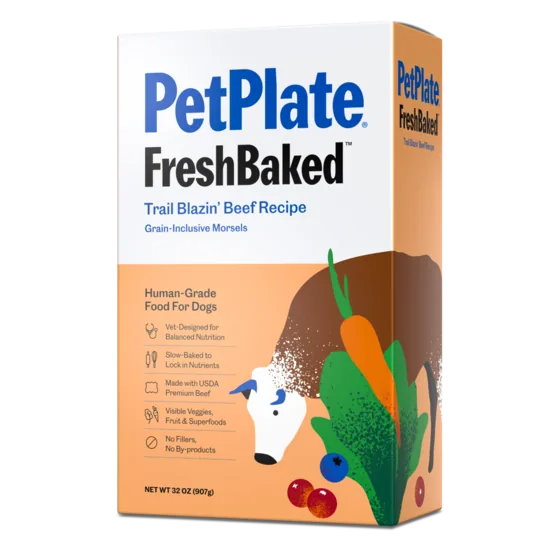
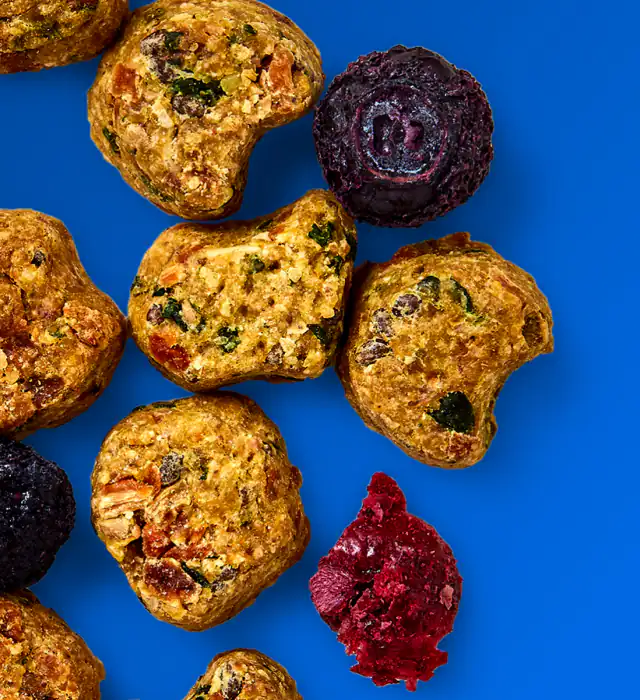
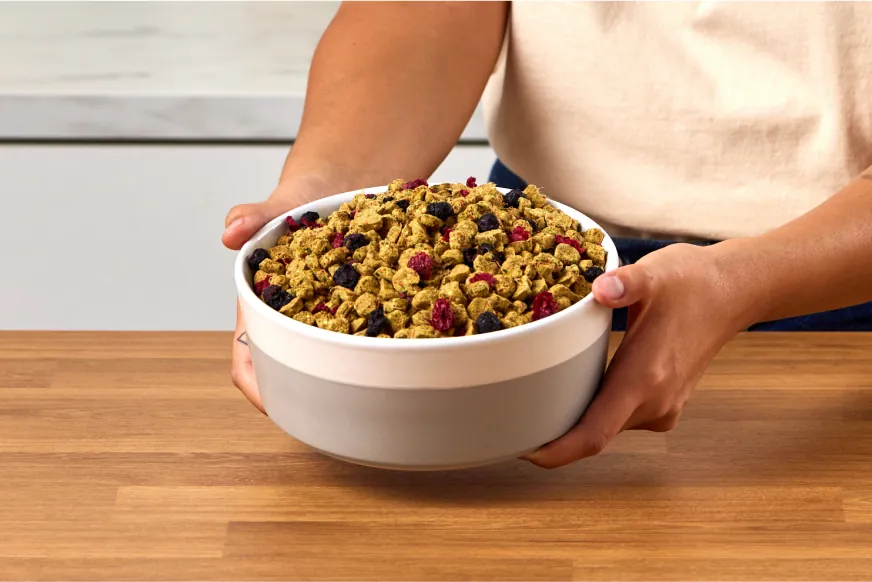
How the baked side is built is unusual enough to be worth a paragraph. PetPlate says the mix is paddle blended to keep ingredients whole, gently pressed into a bite-size cluster and slowly tunnel-baked, rather than coarsely ground, extruded and high-heat treated. That is why the pieces in the photograph at the top of this page have edges and inclusions instead of the identical geometry of a die-cut pellet, and why the dried blueberries and cranberries in the recipe are still recognizable as fruit.
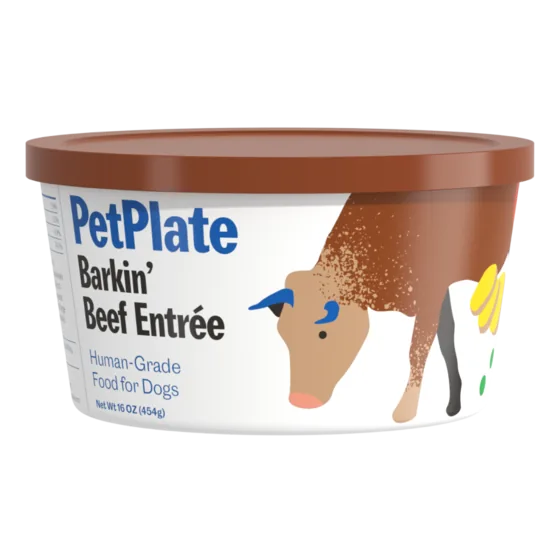
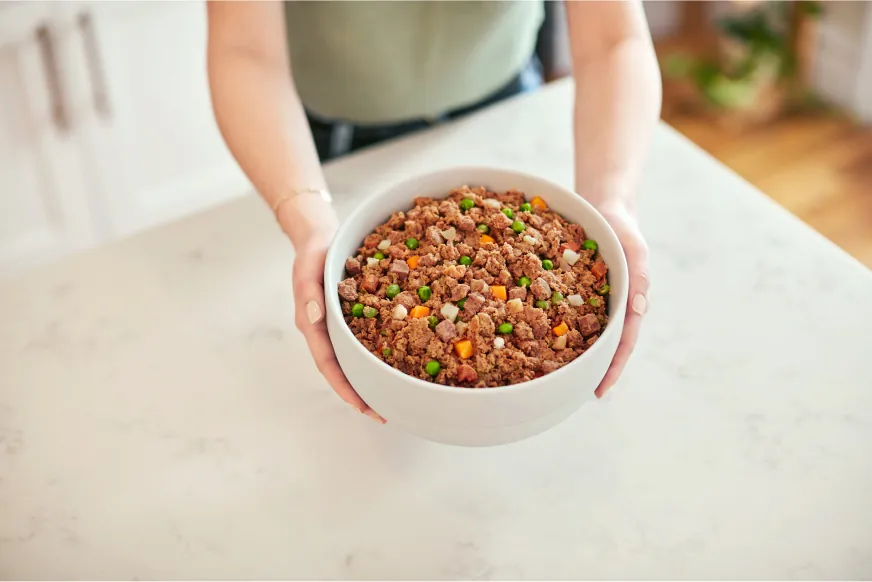
On the cooked side the same idea shows up as pieces you can name. Barkin’ Beef reads, in order: beef, sweet potatoes, potatoes, beef liver, peas, carrots, apples. Seven recognizable foods before you reach the first added mineral.
 Beef
Beef Sweet potato
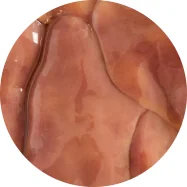 Liver
Liver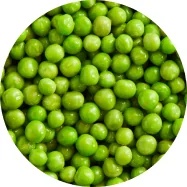 Peas
Peas Carrots
Five of the first seven ingredients in Barkin’ Beef, in the order the label lists them. Photos: petplate.com
Seven recipes, two textures, and why that is the actual product
Most dog food brands sell one formula and then vary the bag size. PetPlate’s founding line is the opposite claim, and it is printed on their own process page: “Dogs are one of the most diverse species on Earth.” Followed by: “It’s time to feed them like it.”
| Recipe | Protein | Moisture | Energy | Carbohydrate base |
|---|---|---|---|---|
| Barkin’ Beef gently cooked | Beef | 74.7% | 41 kcal/oz | Sweet potato, potato. Grain free |
| Chompin’ Chicken gently cooked | Chicken | 70.0% | 39 kcal/oz | Sweet potato, red lentils. Grain free |
| Tail Waggin’ Turkey gently cooked | Turkey | 70.0% | 38 kcal/oz | Brown rice. Grain inclusive |
| Lip Lickin’ Lamb gently cooked | Lamb, novel | 75.5% | 40 kcal/oz | Sweet potato, quinoa. Grain inclusive |
| Lean & Mean Venison gently cooked | Venison, novel | 72.0% | 35 kcal/oz | Potato, pasta. Grain inclusive |
| Roost Rulin’ Chicken slowly baked | Chicken | 10% | 370 kcal/cup | Lentils, chickpeas. Grain free |
| Trail Blazin’ Beef slowly baked | Beef | 10% | 413 kcal/cup | Oats, chickpeas. Grain inclusive |
Scroll the table sideways for the full row. Specifications as published on petplate.com on August 20, 2026. All seven are formulated to meet AAFCO Dog Food Nutrient Profiles for growth and adult maintenance.
Two of the five cooked proteins, lamb and venison, are novel proteins. That matters for a dog with sensitivities, and it happens to be the strongest single lever available for a dog who has met chicken and beef at every meal of his life. The venison recipe is also the lightest of the seven at 35 kcal per ounce. The turkey is the only one built on brown rice.
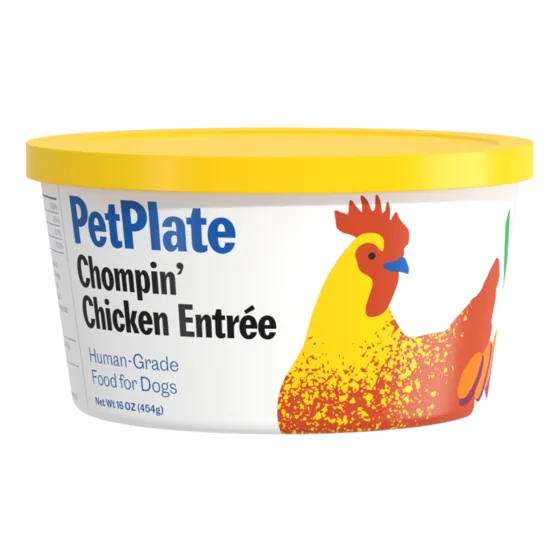
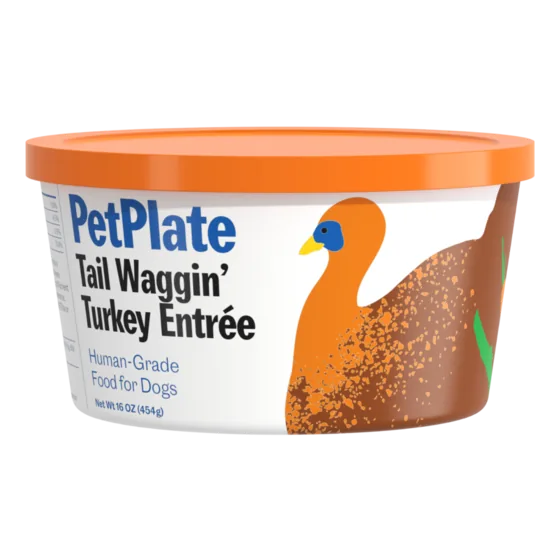
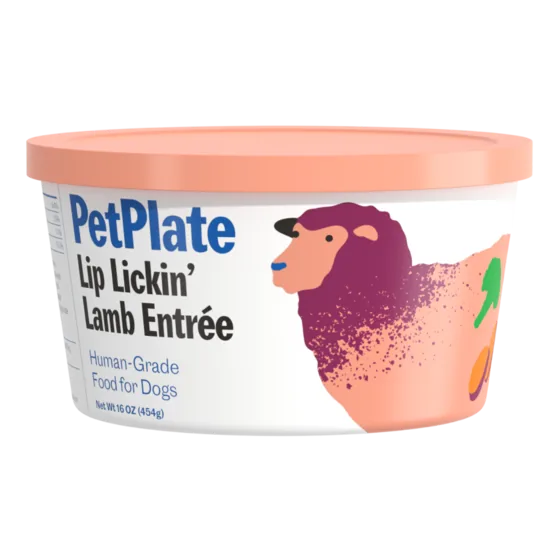
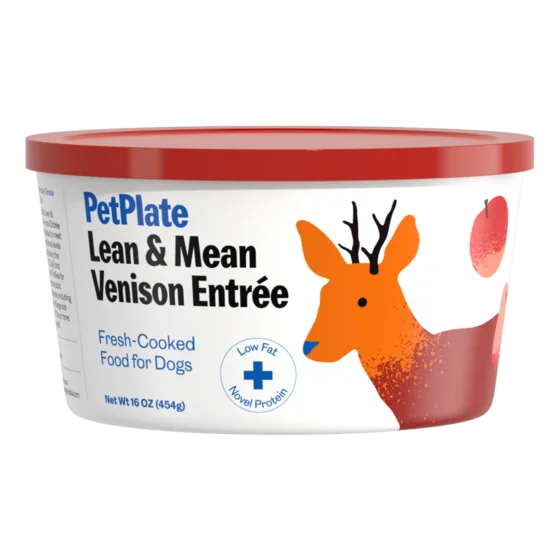
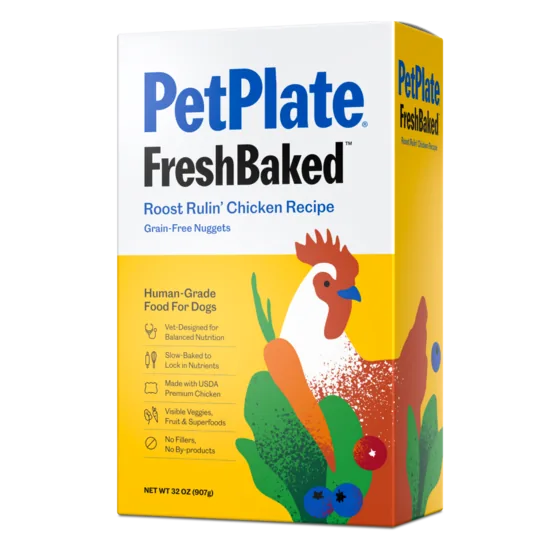
Six of the seven. Trail Blazin’ Beef, the second baked recipe, is shown further up. Photos: petplate.com
The plans are built around mixing rather than committing. There is a FreshCooked plan, a FreshBaked plan, and a FreshCombo that runs both, which the company describes as “the perfect blend of crunchy and chunky”. A Topper Plan is 25 percent of a Full Plan, which makes it the cheapest honest way to run the test on a dog you are unsure about. Published starting prices are $1.29 a day on a Full Plan and $0.51 a day on a Topper Plan.
See the seven recipes Five gently cooked, two slowly baked, on petplate.com The reviews831 published reviews, and one word that keeps turning up in the good ones
PetPlate publishes its customer reviews on its own site. There are 831 of them, dated from May 2017 to July 2026, 785 from verified buyers, averaging 4.9.
Start with the caveat, because it matters. This is a brand’s own review feed and it skews high: 764 of the 831 sit at five stars. So the rating is not the finding here. The wording is.
Read all 831 and count the ones using the words picky, fussy or finicky. There are 74, roughly one review in eleven. Sixty-nine of those are five-star. Not one of the 74 is a complaint about a picky dog. In every case the word appears in the past tense, describing the dog the owner used to have.
Counted across the full public review feed behind petplate.com/reviews, August 20, 2026. Word matching, so the numbers are a floor rather than a ceiling.
That last figure is the one worth pausing on. Seventy-eight reviews describe an action rather than an outcome: running to the bowl, licking out the container, begging, waiting by the kitchen, eating fast. That is precisely the home-side signal the kennel protocol is structurally unable to record, arriving unprompted, from people who were not asked for it.
“Our pup, who has been a picky eater with other specially made foods, enjoys PetPlate! Having the variety of foods keeps her interested every meal.”
Marian H. · verified buyer · five stars · July 7, 2025 · petplate.com/reviewsThe clearest single account of what monotony looks like from the kitchen floor comes from a four-star review, not a five, which is part of why it is worth quoting at length.
“I have tried just about all of the human-grade pet food shipped to my home for my Chihuahua. She loves everything the first time she tries it, so I order more, and she won’t eat it. This is the first food that she is STILL eating after 3 orders. She is not crazy about the Lamb, so I won’t order any more of that. [...] Her favorite is the beef, but I have to give her variety so I also order the chicken and turkey.”
Rebecca C. · verified buyer · four stars · October 27, 2021 · petplate.com/reviewsA dog that loves every new food once and then quits on it is not a dog with an opinion about recipes. It is a dog telling you the variable is novelty. Rebecca’s solution was not a better formula. It was three of them in rotation, and she found it by running the experiment herself.
“Took me a year and a half to find a food that Raven would eat and enjoy. Spent a ton of money on all sorts of food; dry, freeze dried, raw, fresh, made at home, adding toppers, etc. You name it, I tried it. FINALLY PetPlate came to the rescue! Raven loves not just 1 or 2, but EVERY recipe.”
Dawn · five stars · September 22, 2022 · petplate.com/reviews“Our three-year old Frenchie has been eating Pet Plate for two months now & absolutely LOVES it. He’s a picky eater who always needed to be coaxed to his food bowl with his favorite treat. Now, he runs to his bowl at mealtime & rarely looks for a treat.”
Dewanna G. · verified buyer · five stars · May 22, 2021 · petplate.com/reviews“My pups are picky eaters. Both Shih Tzus. They gobble it down. Both have started barking when it is time to eat.”
Loma G. · verified buyer · five stars · February 27, 2024 · petplate.com/reviews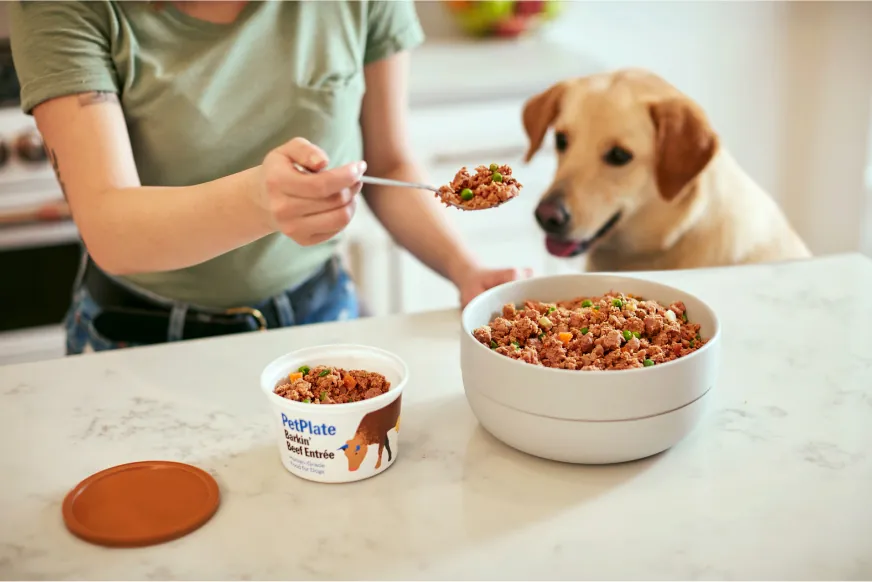
Where this argument stops
Four honest boundaries, because a page that only argues one way is not worth much.
1. A dog that stops eating may be ill, and no menu fixes that
Appetite loss is a symptom before it is a preference. Dental pain, nausea, kidney and liver disease, endocrine disorders and plain stress all suppress eating, and a dog that suddenly stops eating a food it has liked for months is a veterinary question, not a shopping question. Clear that first. The founder’s own dog, the one this company exists because of, had digestive disease alongside the refusals.
2. The novelty effect is documented in cats. In dogs it is less settled.
The formal name for food boredom is the monotony effect, described as reducing “the perceived palatability of foods that have recently formed a large proportion of the diet, in favor of foods with contrasting sensory characteristics”. In Bradshaw’s review that passage is about cats, not dogs. On the dog side, the evidence on this page is owner-reported rather than experimental. Treat rotation as a strong, cheap, one-week hypothesis about your own dog, not as a settled law about the species.
3. Not every dog likes every protein, and that is the point
A menu only helps if you are willing to read the result. One PetPlate customer reports that her dog “did not like the chicken at all, but loved the beef”, and that the company swapped it. Another says her dog is “not crazy about the Lamb”. Those are not failures of the product. They are the assay working: a preference, with a name attached.
4. More textures is not permission to feed more
Rotation changes what is in the bowl, not how much. PetPlate portions by the dog rather than by the scoop, which removes most of the arithmetic, but a topper poured on top of a full meal is still added calories. A Topper Plan is 25 percent of a Full Plan by design, and there is no sample size available: what the company publishes instead is a 100 percent money-back guarantee on a first order.
The kitchenWho built it, and why that is relevant rather than decorative
PetPlate exists because of a dog who would not eat. The company tells the story on its own process page: Renaldo Webb’s first dog, Winston, “had serious digestive issues and constantly refused his food”. What reframed it was not a vet visit. It was Webb’s job taking him onto the floor of large pet food factories, where what he saw made the refusals look less like a temperament and more like a message. Their sentence for the turn is the one this whole article has been circling: “That’s when Renaldo understood what Winston had been telling him.”
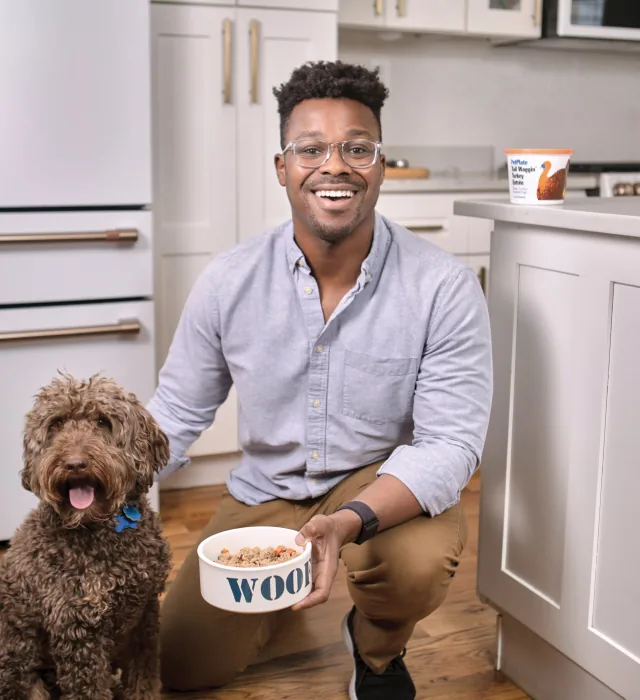
The recipes are built with Dr. Renee Streeter, a board certified veterinary nutritionist. PetPlate describes her contribution in a word order worth noticing: expertise in creating “highly palatable, perfectly balanced meals for a wide range of breeds”. Palatable first. Most brands would not have written it that way around.
And the company’s summary of its own position is the shortest statement of the argument on this page: “At PetPlate, we don’t make dog food. We make food for dogs.”
TonightHow to run the test on your own dog
- Rule out the vet visit first. A change in appetite is a medical question until a professional says otherwise.
- Give any new food more than one night. The published work used nine days for the hesitation to fade. Two nights tells you nothing about a recipe and a great deal about novelty.
- Introduce at about 25 percent of the meal and raise it slowly, which is PetPlate’s own instruction and also standard advice for any switch.
- Change one thing at a time. New protein, or new texture, or new schedule. Not all three, or you learn nothing.
- Rotate proteins and write down which one wins. You are running a two-pan test in series instead of in parallel, on the only panel of dogs whose opinion you actually need.
- Score the behavior, not the bowl. Seconds from container to first bite. Whether he stays through the meal. Whether the empty container comes back licked. Those are the readings the kennel cannot take and you can.
Picky costs nothing to say, and it ends the conversation. A menu costs a little more and keeps it open. Your dog has around 730 dinners between now and this time next year. He can taste every one of them.